


Preppi
Developing structure for neurodiverse college students through flexible routine creation.
College removes all the structure high school built for you.
High school provides neurodivergent students with scaffolding through fixed schedules, consistent environments, and parental support. This aids executive function systems that are often unreliable.
When college removes all existing structure, students are expected to build it themselves for the first time. This often results in overwhelm, time blindness, neglected basic needs, and chronic stress.
The problem
High-achieving neurodivergent students know structure helps, but routines are difficult to build and even harder to sustain. No existing tool makes starting and maintaining them accessible.
Current tools focus on productivity, not wellbeing
While the planner and to-do list space is oversaturated, most tools focus on task completion and productivity to build habits. There's a gap in providing an encouraging, wellbeing-focused direction to start developing structure.



Encouraging, wellbeing-focused, giving students a place to start developing structure.
Why students struggle with structure
-
Days aren't predictable enough for rigid structure Energy, focus, and capacity shift daily, making time estimation difficult and rigid time-blocked systems impossible to maintain. When tools can't adapt, they get abandoned.
-
Self-worth is tied to productivity Students described being motivated by consequences and fear of failure, not rewards. But when tools added guilt or pressure on top of that, they disengaged entirely.
-
Overwhelm manifests physically, not just mentally Migraines, crashes, panic attacks, skipping meals, and sleep deprivation were noted as consequences of a lack of structure, not just productivity loss.
Two key behavioural states emerged
Based on research and interviews, I found two states that neurodivergent people typically move through in response to feeling overwhelmed. The same person can flow in and out of both.
Overloaded
Packed schedule, no rest
Too many responsibilities and an over-packed schedule leave no room to rest, leading to burnout and crash.
Avoidant
No system, too much freedom
Unstructured time with no system leads to paralysis. Days blur together and nothing gets done.
Overwhelm is a cycle, not a one-time scenario
This cycle of academic overwhelm maps the recurring pattern neurodivergent students experience throughout their academic life. It's not just about productivity. It's a shame-fuelled habit loop that compounds over time, ultimately leading to neurodivergent burnout and skill regression.
How might we help neurodivergent college students build flexible, shame-free daily structure?
Guiding design principles
The following design principles were created based on insights and findings, in order to develop a product that meets neurodivergent students' needs.
Flexible
Adapts to how neurodivergent students experience their day, changing priorities, and unpredictability, while remaining accessible whenever they're ready to return. Visibility is also non-negotiable, and too much friction leads to abandonment.
Supportive
Through thoughtful, encouraging language, visuals, and guidance on where to start, to help students build a positive sense of self rather than reinforcing their perceived "failures."
Well-being first
Prioritizing sleep, meals, and self-awareness over productivity metrics, to feel more grounded and prepared for their days, allowing space to build their own metacognitive skills.
Validating assumptions through paper and mid-fidelity testing
I sought to test my assumptions and make sure my design patterns made sense for my audience, especially at first glance. I achieved this through preference testing and multiple rounds of paper and mid-fidelity testing. I tested three flows for creating a routine: step-by-step, AI dump, or manual blocking.
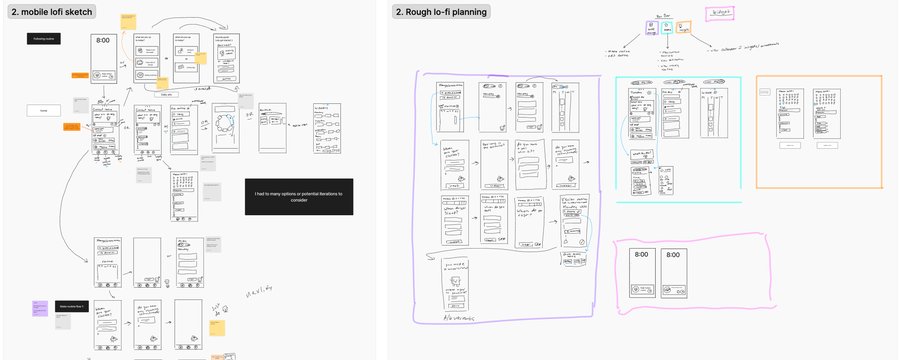
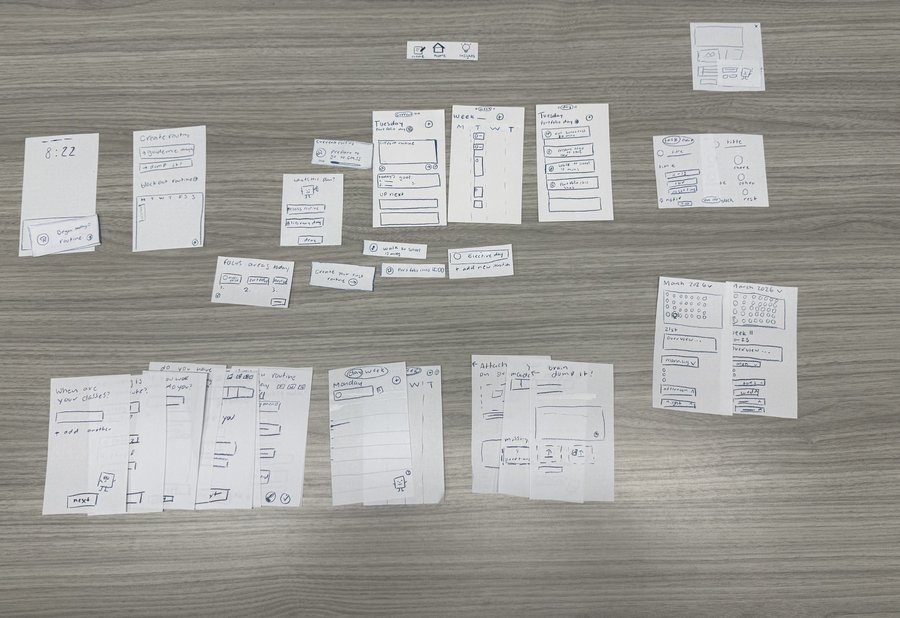
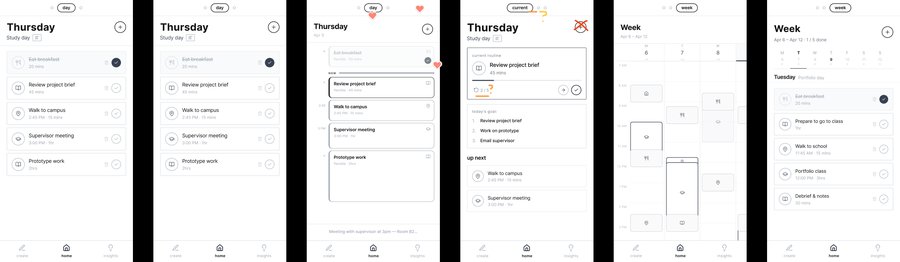
Paper prototypes
Mid fidelity
Using Figma Make, I jumped from paper prototypes into mid-fidelity using a long, structured prompt that set guidelines for layout structure, target audience, and interactions on each screen. I rapidly tested different screen layouts and usability with a given task. I eliminated several biases, including prioritizing three ways to create a routine for the MVP, and found that step-by-step initial creation was the most meaningful for the product's value proposition.
Participants prefer inputs and design patterns that follow their expectations & mental models.
Step-by-step routine creation is still the most valuable and self-reflective.

Preppi
A mobile app and widget that supports neurodivergent college students through flexible routine creation, from start to action, helping them feel more at ease in their day to day.
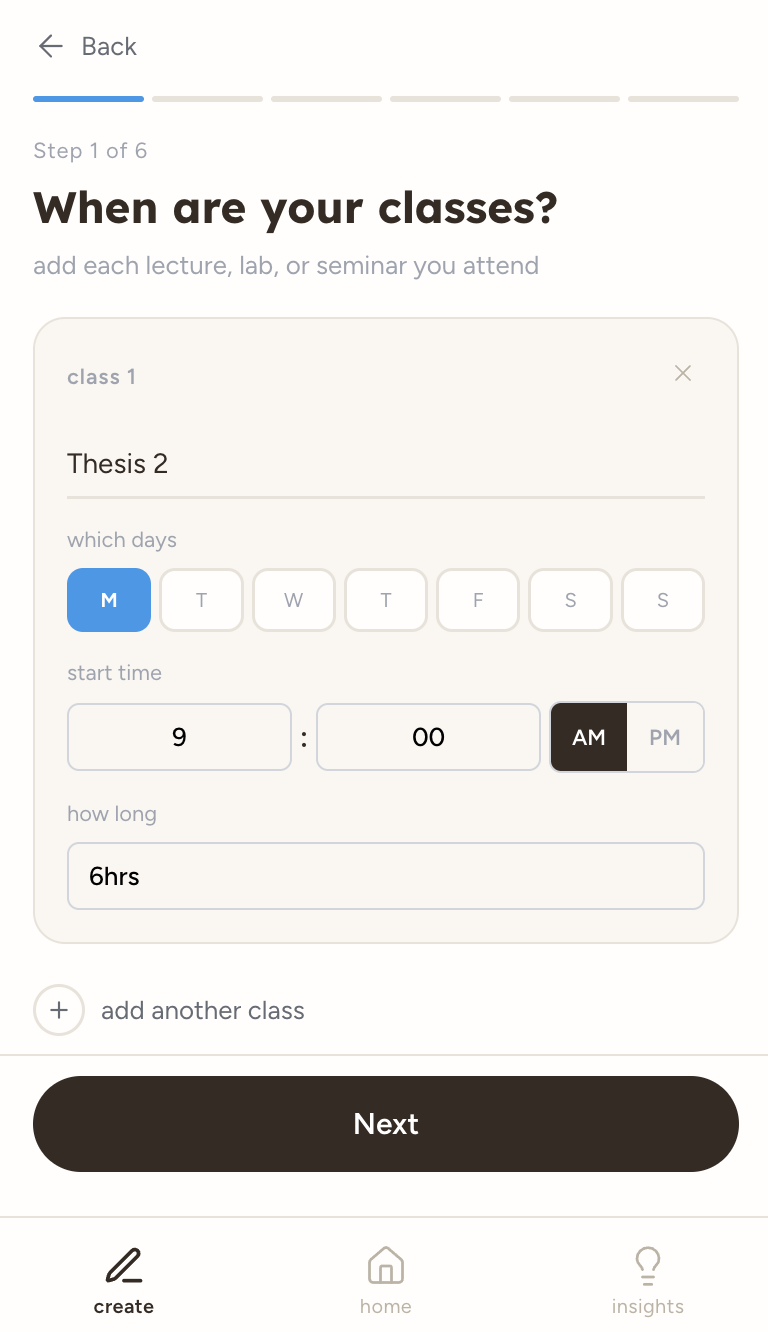
Routine creation
Allows students to make their own flexible routine from scratch, using their class times as a base.
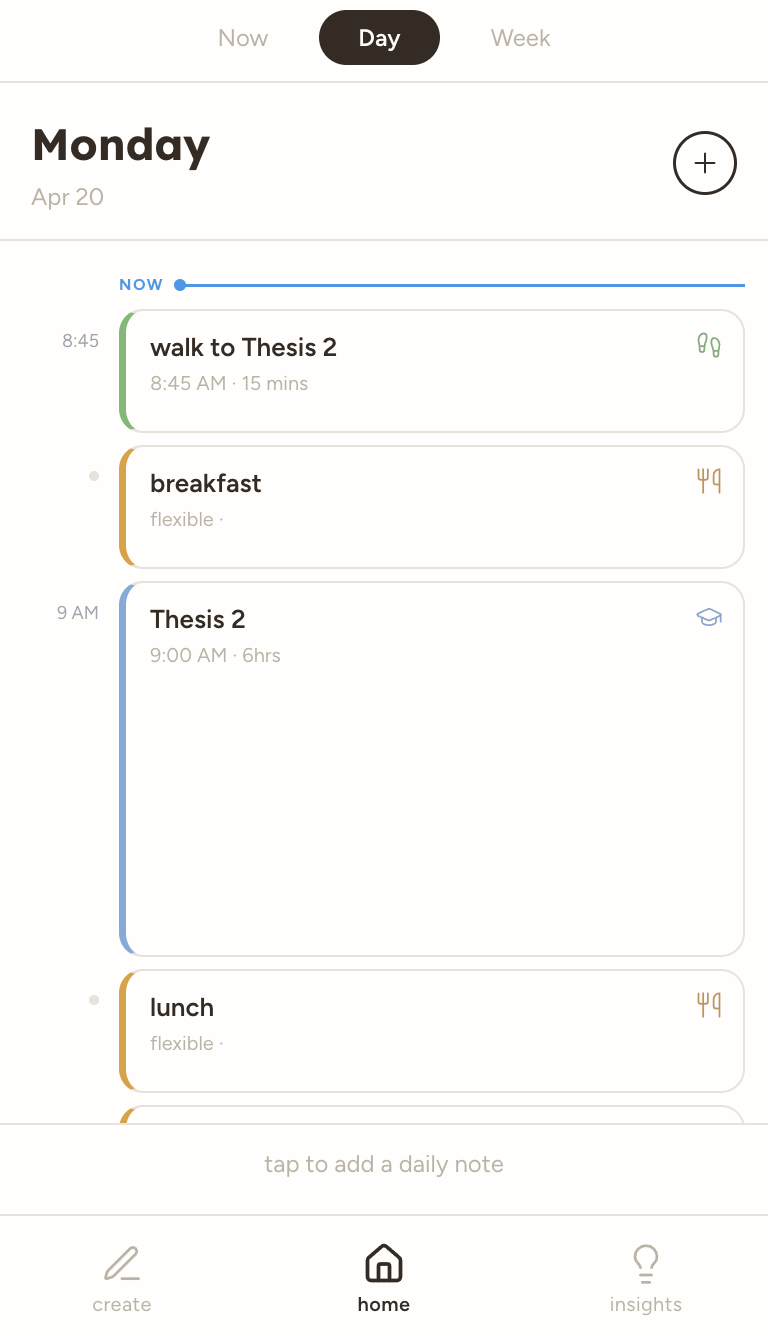
Day overview
Students get an overview of what the rest of their day or week looks like at a glance, visualizing needs and responsibilities, and editing as needed.
Activity widget
Gives a gentle visual indicator to view where you are in your current routine, right from the lock screen.
Touch targets came out too small
The back button and the day-of-week selector came out smaller than they should be. Apple's Human Interface Guidelines and WCAG 2.5.5 both recommend at least 44×44pt so a tap reliably lands on the intended target.
Human craft should always be valued and prioritized
After my discover and define phases, I designed and mapped out my core features and wanted to experiment with AI capabilities. What surprised me most was how fast AI could take the process from manual sketches to a working digital screen, turning paper wireframes into tappable mid-fidelity screens in a single prompt session. But AI can only take a design so far. It can't keep the soul and integrity of the product intact on its own. I plan to go back through the final screens, test, revise, and polish manually. I'd also like to build out my own design system for Preppi and experiment with how accessible guidelines and styles can be kept consistent throughout.
Where AI fits in next: a brain-dump entry point
One of the three routine-creation flows I tested was an AI-powered "brain dump": upload a syllabus or timetable and let AI pull out your classes and commitments automatically, instead of entering each one by hand.